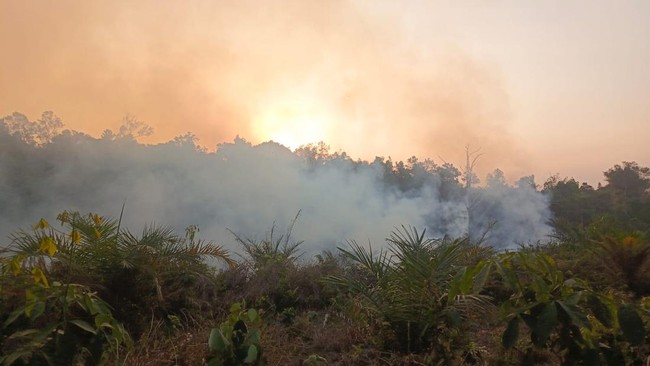
Jakarta – Forest and land fires in several parts of Indonesia are beginning to have cross-border impacts. Smoke from fires in Sumatra and Kalimantan has been observed moving with the wind toward several Southeast Asian countries.
At least four countries have been affected or are potentially affected by the spread of the haze: Malaysia, Brunei Darussalam, the Philippines, and Singapore.
A report by Malaysia’s national news agency, Bernama, said smoke from forest and land fires in Sumatra and Kalimantan was moving toward the Malacca Strait and the Natuna Sea. The movement has increased the potential for transboundary haze to affect parts of Malaysia, Singapore, and Brunei Darussalam.
Smoke from hotspots in West Kalimantan has also been observed moving northward into Sarawak, Malaysia. The situation has contributed to deteriorating air quality in several areas of East Malaysia.
The ASEAN Specialised Meteorological Centre (ASMC) has also detected moderate levels of transboundary haze in several parts of the Philippines, including Palawan and Panay.
In its daily report, the ASMC said moderate to dense smoke plumes were observed over parts of Kalimantan, Sabah, Sarawak, Brunei Darussalam, and the Philippines.
“Amid prolonged dry conditions, hotspot and haze situations are expected to remain elevated in fire-prone areas, with continued risk of severe transboundary haze,” the ASMC said.
Malaysia Affected by Haze
Malaysia was among the first countries to experience the effects of haze from Indonesia’s forest and land fires.
In Sarawak, haze conditions previously prompted the state government to temporarily suspend in-person classes in several areas. The Sarawak State Education Department closed schools in Kuching, Padawan, Serian, and Samarahan for two days, on August 20 and 21.
During the school closures, authorities implemented home-based teaching and learning to ensure that educational activities could continue.
Philippines Begins to Feel the Impact
The haze has also reached the Philippines. Manila’s skies appeared hazy on Tuesday (September 1), with the smoke reportedly originating from forest fires in Kalimantan and being carried by winds toward parts of Luzon and the Visayas.
The Philippine Department of Health subsequently urged residents to wear N95 masks and reduce outdoor activities. Authorities warned that the haze contains a mixture of fine particles, dust, and ash that could pose health risks.
“Haze can cause difficulty breathing, coughing, chest pain, eye irritation or watery eyes, and worsen lung diseases such as asthma. Extra caution is needed for children, the elderly, and people with pre-existing lung or heart conditions,” the Philippine Department of Health said on Tuesday (September 1).
Philippine Environment and Natural Resources Secretary Juan Miguel Cuna said the government had also recorded increased concentrations of air pollution, particularly fine particulate matter known as PM2.5.
“There are areas experiencing increased levels of air pollution, particularly PM2.5, due to an incident in another country that is currently being carried here. Therefore, we are monitoring the situation,” Cuna said on Tuesday (September 1).
Several areas around Manila, Central Luzon, Calabarzon, and Mimaropa have been monitored for haze conditions since the beginning of the week.
Air quality in several parts of Manila on September 1 was recorded in the “very unhealthy” to “hazardous” categories.
Brunei Darussalam Blanketed by Haze
Brunei Darussalam has also experienced hazy conditions since August 18, 2026. On August 31, visibility at the Meteorological Observation Station at Brunei International Airport reportedly fell to around 2 kilometers as haze conditions worsened.
The ASMC’s Regional Haze Map showed that hotspots remained active, particularly in southern Kalimantan. Winds from the southwest then carried the smoke toward northern Kalimantan and across Brunei.
Brunei’s Ministry of Health warned the public about potential health problems caused by exposure to haze. These may include coughing, eye irritation, and a runny nose, as well as the worsening of existing conditions such as asthma, lung disease, and heart disease.
The public was also advised to maintain personal hygiene, wash their faces and hands after outdoor activities, and wear masks. People with chronic illnesses were reminded to continue taking their medication as prescribed by their doctors.
Singapore Could Also Be Affected
Singapore could also once again be affected by haze from Indonesia. Singapore’s National Environment Agency (NEA) had previously detected increased hotspot activity in Kalimantan and southern Sumatra.
“We observed an increase in hotspot activity and haze over the weekend. Hotspots and dense smoke plumes were mainly detected in Kalimantan and southern Sumatra,” the NEA said in a Facebook post on Monday (August 24).
The NEA also reported smoke plumes over parts of Riau. The prevailing dry conditions were considered a factor that could increase the risk of haze spreading.
“With winds blowing from the south or southeast, haze may affect Singapore intermittently,” the NEA said, as reported by Channel News Asia.
The cross-border haze is occurring as several parts of Indonesia continue to experience dry conditions and forest and land fires. The movement of smoke is heavily influenced by wind direction and patterns, allowing its effects to extend beyond Indonesia to other countries across Southeast Asia.