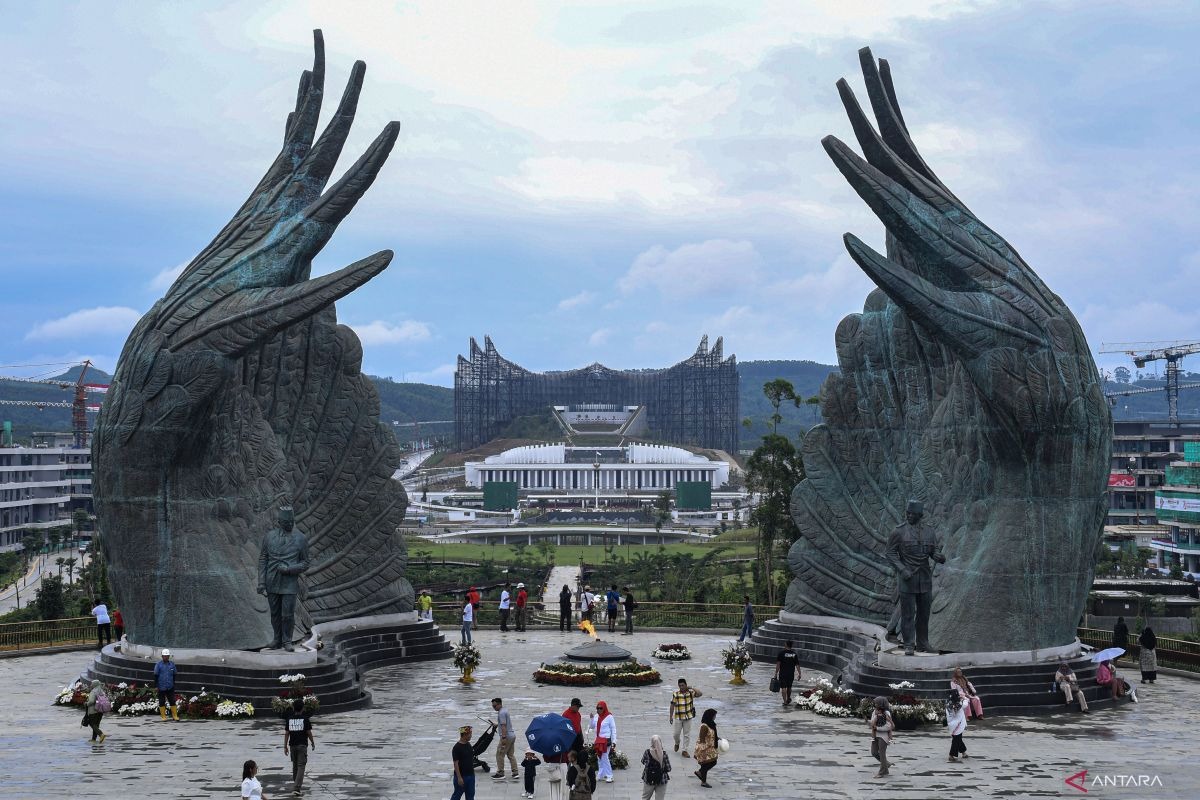
The development of Indonesia’s future capital, Nusantara Capital City (IKN), has entered an increasingly mature phase. A number of strategic infrastructure projects have shown remarkable progress. As of May 2026, the IKN Toll Road Segment 5B connecting Pulau Balang Bridge to Simpang Riko had reached approximately 96.24% completion, while Segment 3A-2 connecting Karangjoang to Kariangau had achieved around 88.35% completion. Within the Core Government Center Area (KIPP), the average progress of the seven Road Packages 1B–1C has also reached approximately 99%, indicating that connectivity among government offices, educational facilities, residential areas, and public services is nearly complete.
These achievements demonstrate that the development of IKN is no longer merely an ambitious vision but has evolved into a tangible national development project. Nevertheless, the success of such a strategic initiative should not be measured solely by the percentage of physical completion. Its true success will ultimately be determined by how effectively it fulfills its constitutional objectives, is managed transparently and sustainably, earns public legitimacy, and delivers meaningful benefits in promoting equitable development throughout Indonesia.
A Strong Legal and Conceptual Foundation
From the perspective of constitutional and administrative law, the development of IKN rests upon a clear legal foundation. It is principally governed by Law No. 3 of 2022 on the National Capital, as amended by Law No. 21 of 2023, together with a series of implementing regulations. These legal instruments establish the institutional framework, spatial planning, financing mechanisms, development governance, and long-term direction for Indonesia’s governmental transformation.
Conceptually, IKN is not merely intended to relocate Indonesia’s administrative center from Jakarta to East Kalimantan. Rather, it is designed as a comprehensive instrument of national transformation aimed at reducing regional development disparities, creating new engines of economic growth, strengthening national territorial integration, and building a smart, sustainable, climate-resilient, and forest-based capital city.
From an academic perspective, therefore, the concept underlying IKN is fundamentally sound. The principal challenge moving forward lies not in the strength of the vision itself, but in the consistency and quality of its implementation. Ultimately, the effectiveness of any public policy is determined not by the excellence of its design, but by the quality of its execution.
Public Oversight Begins with Public Understanding
In public policy studies, meaningful public oversight begins with adequate public literacy. It is difficult for citizens to monitor or evaluate a policy effectively without first understanding its objectives, legal foundation, implementation framework, and indicators of success.
For this reason, the public should develop a comprehensive understanding of IKN as outlined in the governing laws and implementing regulations. This includes its development strategy, implementation phases, financing model, governance framework, environmental safeguards, and long-term development goals.
The media therefore plays a strategic role as one of the pillars of democracy. Its responsibility extends beyond reporting construction progress or political debates. It should also serve as an educational platform by providing comprehensive, accurate, and evidence-based information to the public.
The greater the public’s understanding of the IKN project, the more constructive and meaningful public participation will become. Criticism will be grounded in evidence and aimed at improving policy, while support will be based on informed understanding rather than emotion or sentiment.
Major National Projects Inevitably Face Major Challenges
International experience demonstrates that large-scale national development projects almost always encounter multidimensional challenges. These may include financing constraints, bureaucratic complexity, human resource readiness, technological developments, global economic uncertainty, and shifting geopolitical dynamics.
From the perspective of international relations, competition among nations is no longer limited to economics and defense. It increasingly involves competition over information, public narratives, and strategic influence. Consequently, society must develop strong information literacy to distinguish constructive criticism from misinformation or narratives driven by particular interests.
This does not imply that criticism should be viewed negatively. On the contrary, criticism is an essential component of a healthy democracy. However, responsible criticism should be based on facts, sound analysis, and a genuine commitment to improving public policy, rather than fostering pessimism or deepening social polarization.
The larger a nation’s strategic project becomes, the greater the need for national unity. Therefore, society should remain vigilant against unverified information and narratives that could undermine collective confidence in the country’s long-term development.
IKN Is a National Endeavor
The development of IKN is a nationally strategic project with a solid legal mandate. Its success, therefore, cannot rest solely upon the President or the central government.
State institutions, regional governments, businesses, academic communities, the media, civil society organizations, professional associations, and the broader public all share a moral responsibility to oversee the project in accordance with their respective roles and responsibilities.
Objective oversight, consistent transparency, continuous evaluation, and evidence-based criticism are fundamental principles of good governance. The broader the public participation, the greater the likelihood of achieving sustainable success.
Statesmanship Guided by Pancasila
A project of IKN’s magnitude requires statesmanship rather than short-term political calculations. The values of Pancasila provide the moral foundation for Indonesia’s national development by emphasizing unity, deliberative democracy, social justice, mutual cooperation, and the prioritization of national interests above sectional interests.
Viewed from this perspective, the success of IKN should not be measured solely by the completion of government buildings, highways, or infrastructure. Its true success will be realized when it becomes a symbol of governmental transformation, accelerates equitable national development, creates new centers of economic growth, enhances Indonesia’s global competitiveness, and strengthens national unity.
IKN represents a long-term investment whose benefits will extend across generations. Therefore, optimism must be maintained—but it should always be accompanied by objective oversight, consistent transparency, continuous evaluation, and active participation from all segments of society.
Ultimately, the success of IKN will not belong solely to the government. It will represent Indonesia’s collective achievement in demonstrating its capacity to envision, build, oversee, and pass on a modern capital city founded upon constitutional principles, scientific knowledge, sound governance, and the enduring values of Pancasila.
AUTHOR: ARI SUPIT
Forum Bersama Ibu Kota Nusantara