Jakarta – Indonesia’s poverty rate according to the World Bank differs significantly from data released by Statistics Indonesia (BPS). The World Bank estimates that more than 64 percent of Indonesia’s population will be living below the poverty line in 2026. Meanwhile, BPS records the national poverty rate at 8.07 percent, equivalent to around 22.93 million people.
The difference does not indicate conflicting data. Rather, the World Bank and BPS use different poverty-line standards and have different purposes for measuring poverty.
BPS explained the difference in a post on its official Instagram account on Wednesday (September 2, 2026).
“The difference in these figures does indeed appear quite large, but it is important to understand wisely that the two figures are not contradictory,” BPS stated.
“The difference arises because different poverty-line standards are used and for different purposes,” the statement continued.
World Bank Uses Global Poverty Standards
In its April 2026 Macro Poverty Outlook, the World Bank estimated that more than 64 percent of Indonesia’s population would be living below the poverty line in 2026.
The calculation uses the poverty line for upper-middle-income countries of US$8.30 based on 2021 purchasing power parity (PPP).
The exchange rate used in the calculation is not the current US dollar-to-rupiah exchange rate. Based on 2021 PPP, US$1 is equivalent to Rp5,353.56 per capita per day.
The World Bank uses three poverty-line standards to monitor global poverty reduction and compare poverty levels across countries: the International Poverty Line, Lower-Middle-Income Poverty Line, and Upper-Middle-Income Poverty Line.
These standards are expressed using PPP, a conversion method that adjusts for differences in purchasing power between countries.
BPS Uses Basic Needs Approach
Meanwhile, BPS recorded Indonesia’s poverty rate at 8.07 percent in March 2026, equivalent to around 22.93 million people.
BPS uses a national poverty line, which stood at Rp3,091,866 per household per month in March 2026.
BPS measures poverty using the Cost of Basic Needs (CBN) approach, which is based on the minimum expenditure required to meet basic food and non-food needs.
For food needs, the standard is a minimum of 2,100 kilocalories per person per day. The commodities included in the calculation include rice, eggs, tofu, tempeh, chicken and vegetables.
Non-food needs include housing, education, healthcare, clothing and transportation.
Both Use Susenas Data
The World Bank and BPS both use data from the National Socioeconomic Survey (Susenas), but apply different approaches to measuring poverty.
The World Bank adjusts changes in prices over time using the Consumer Price Index (CPI). It also adjusts for price differences across regions using a local cost-of-living measure known as the spatial deflator.
In addition, the World Bank uses PPP to adjust for price differences between countries.
BPS does not use PPP-based adjustments because its national poverty line is intended to measure poverty conditions specifically within Indonesia.
BPS also calculates and publishes poverty figures in greater detail by region, including provinces and regencies/cities.
Poverty Line Is Not an Individual Spending Limit
BPS also emphasizes that the poverty line is not a spending limit that every individual is required to meet.
The figure is an average measure that does not take individual characteristics such as age, gender or occupation into account.
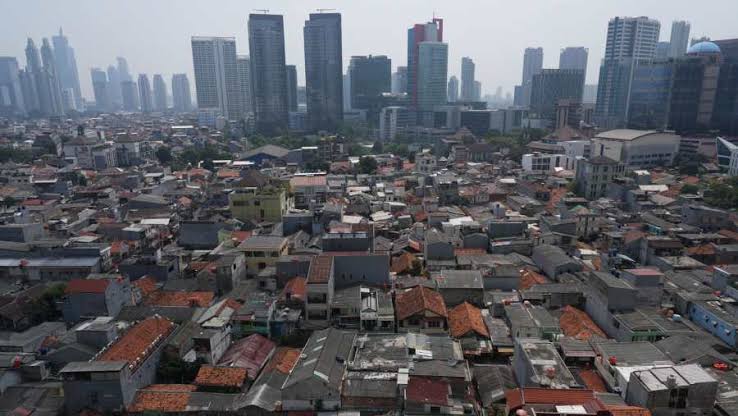
For example, the poverty line in Jakarta in March 2026 was Rp4,525,817 per household per month.
The figure represents the needs of an entire household, including parents and children. However, this does not mean that every member of the household has the same needs or expenses.
The needs of an adult, for example, may differ from those of a toddler within the same household.
“Therefore, the more appropriate approach is to view the poverty line at the household level, as an illustration of the total needs of all family members,” BPS explained.
Thus, the 64 percent figure cited by the World Bank and the 8.07 percent figure recorded by BPS cannot be directly compared because they use different poverty-line standards and measurement approaches.