Government Warns Banks: No Additional Collateral Allowed for KUR Loans Below Rp100 Million

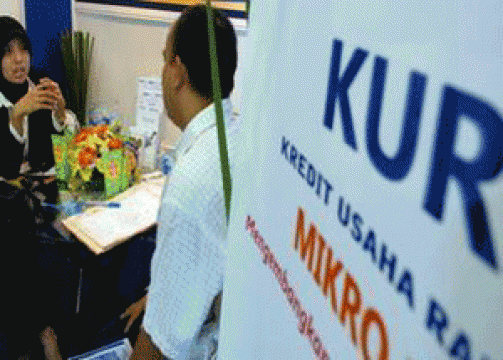
JAKARTA – The Indonesian government has reaffirmed that People’s Business Credit (KUR) loans of up to Rp100 million must not require additional collateral. The public is encouraged to report any bank or party that still demands collateral, charges unauthorized fees, or involves intermediaries in the KUR application process.
Riza Damanik, Deputy for Entrepreneurship at the Ministry of Micro, Small, and Medium Enterprises (MSMEs) and the ministry’s spokesperson, said the provision is stipulated in Coordinating Minister for Economic Affairs Regulation No. 1 of 2026 on Guidelines for the Implementation of People’s Business Credit (KUR). Under the regulation, KUR loans of up to Rp100 million cannot be subject to any additional collateral requirements without exception.
Riza explained that the KUR scheme recognizes two types of collateral: primary collateral and additional collateral. Primary collateral refers to the business or project financed through the KUR loan, along with the borrower’s repayment capacity. Additional collateral, on the other hand, includes assets such as land certificates, vehicle ownership documents (BPKB), or other personal property. For loans of up to Rp100 million, participating banks may only rely on primary collateral and are prohibited from requesting additional guarantees.
He revealed that the Ministry of MSMEs continues to receive public complaints regarding banks allegedly demanding additional collateral, charging service fees, and involving brokers in the KUR application process. Therefore, MSME owners are advised not to use intermediaries or pay any fees to obtain KUR financing.
According to Riza, KUR is one of the government’s flagship programs to expand access to financing for productive businesses that have not yet qualified for commercial bank loans. Supported by state budget subsidies, KUR borrowers are charged an interest rate of only 6 percent, significantly lower than commercial lending rates, which generally range between 10 and 14 percent.
The government has set a 2026 KUR disbursement target of Rp290 trillion. As of July 22, 2026, KUR distribution had reached Rp169 trillion, benefiting approximately 2.65 million borrowers. Of that number, around 1.1 million were first-time recipients of formal financing, while 511,000 MSMEs had successfully graduated to a higher business level. Approximately 65 percent of KUR financing has been directed to productive sectors such as agriculture, fisheries, and manufacturing, while the program’s non-performing loan (NPL) ratio has remained stable at around 2 percent.
To safeguard the integrity of the program, the Ministry of MSMEs has urged the public to actively report any irregularities in KUR distribution. The government emphasized that all reports will be investigated and that sanctions will be imposed on any violations to ensure the program remains transparent, accountable, and effective in strengthening MSME access to financing.